
Opinion, Position, Argument


There is not a strict formula for composing an argument, although arguments are composed and presented all the time in communication. A nice place to begin thinking about how to write decent, strong, persuasive arguments is to distinguish opinion, position, and argument construction. While this might seem fundamental, many thinkers confuse these, believing their statement is an argument or their argument is self evident.
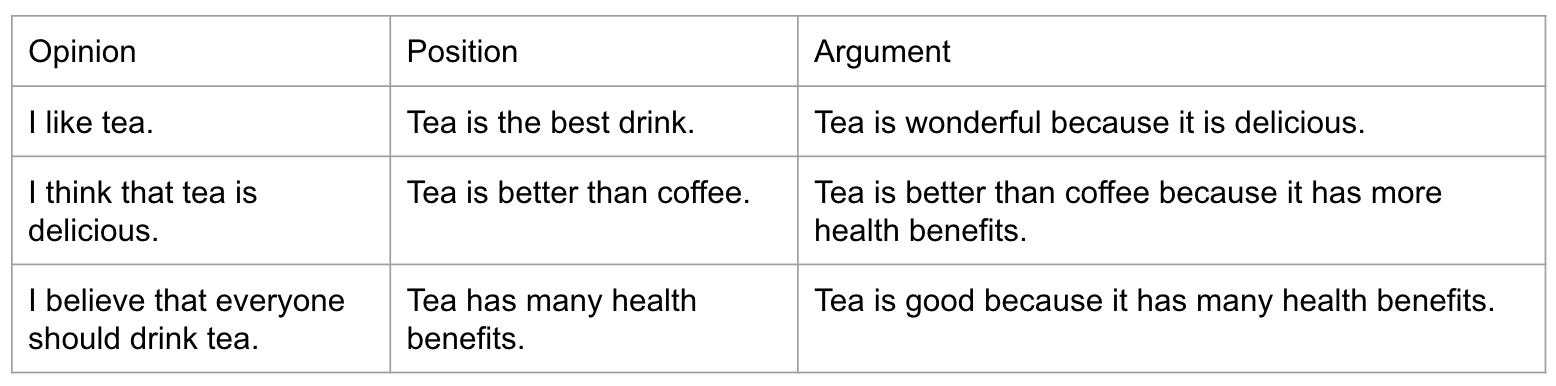
There are distinct but not necessarily independent formulations of opinions and positions. Distinguishing between them will make thinking and communicating more conscious, deliberate, and effective.
An opinion is a statement of a subjective, personal belief. An opinion is a statement that explicitly does or implicitly could express its identity by beginning:
“I think…”
“I feel…”
“I believe…”
“I like…”
“I hate…”
“I want…”
A position is a statement of a perspective. In critical thinking exercises like philosophical dialogue or debate, a position is taken and then arguments are built to prove the position with evidence or warrants. A position is potentially subjective but not necessarily. It need not be assumed that the position is the expression of the author’s personal perspective, nor that offering constructive criticism is attacking the author.
An argument provides the reasoning to take a position or opinion. Perhaps the buzzword “because” is visible which introduces an argument, although thinkers offer weak and strong arguments in many forms. An argument should do the work to express a position and justify the position with some warrants or evidence following logical steps. This work should persuade someone to consider the particular perspective the position takes. The argument should be strong enough to preempt some easy objections to the position, likely enough that it avoids depending on exceptions to common sense, and detailed enough to provide connections, examples, or demonstrations of how the position works.
When writing an argument, think about your reader or listener as someone who does not already believe in your position, or someone who is going to consider arguments for other or even opposite positions. You want your argument to stand for itself and against scrutiny. Consider what objections you might bring to your own argument so you can already address potential objections in what you put forward.
Competency: Argumentation

Argumentation is the art of articulating a reason to justify a position. A position is a statement or claim, an opinion is a belief someone holds, but an argument provides the reasoning to take a position or opinion. We might say “avocados are good,” or “I like avocados,” but we justify these when we add “because avocados are healthy, and healthy foods …